Cultivation
A large portion of mate production takes place in monocultures on cleared plantations. In them, all mate shrubs grow at the same height and are exposed to strong sunlight. To protect themselves from the sun, they produce more acids and caffeine. This can lead to poorly digestible mate tea.
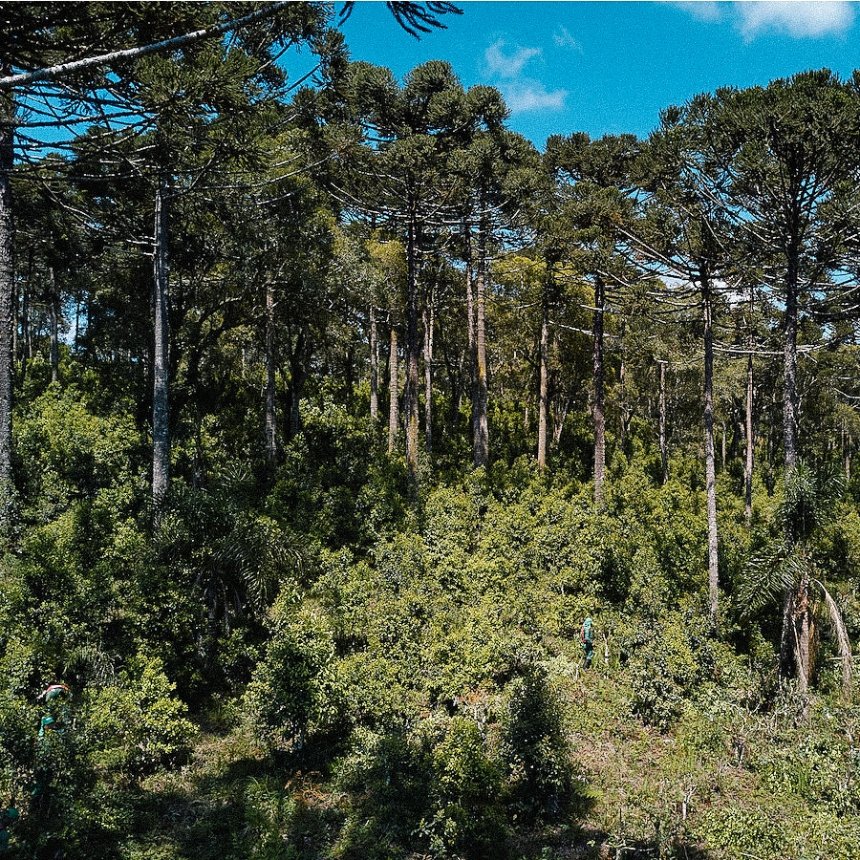
However, our producer's mate plants thrive in mixed plantations, in the middle of the jungle and among the natural vegetation. Not only does this provide them with natural shade, but their symbiotic co-existence with other plants in their original habitat allows them to receive an optimal supply of nutrients, resulting in aromatic, balanced mate tea. Furthermore, the Atlantic rainforest, which is suffering from severe deforestation, is spared, and the planting of new mate trees supports its regeneration. In order to give the plants enough time to recover between harvests, harvesting is alternated between two sections of the plantation. Each plant is given the chance to develop new shoots and gain strength for two years after harvest. The harvest itself is carried out with electric shears, meaning thick branches can be cut off precisely and without crushing the plant, which further enables its regeneration.
The harvested mate leaves are processed by the farmer and dried in a special two-stage process over an open fire made from sustainably planted eucalyptus trees. Thanks to our producer's unique method, the mate leaves never come into contact with the smoke from the fire and its pollutants.
The Origin of Yerba Mate
Historically, mate has been consumed by indigenous groups in South America for more than 500 years. The Guarani, who today live in Brazil, Paraguay, Bolivia, Argentina and Uruguay, were the first to process the mate plant into mate tea by crushing and fire-drying it. They also originated the traditional preparation in a calabash gourd – the eponymous Matí – with a sugarcane straw, known as a Bombilla.
To this day, mate remains a beverage of immense social and cultural significance across many Central and South American countries. Sharing a mate always offers an opportunity to talk, take a break, nurture relationships or gather after a hard day's work. For our farmer's workers, too, not a day goes by without sharing a mate, where the yerba mate is passed around in a large, often elaborately decorated calabash, topped up with hot water from a flask that is always kept close at hand.
Organic Certification

PL-EKO-01
Nicht-EU-Landwirtschaft




![[Teesorte]](https://media.sunday-natural.com/media/catalog/product/cache/206845fc4dee3a159cd9ed4f83c4d3e9/Y/5/Y5231BDE_sunda-yerba-mate-triunfo-green-organic_gruenteesorte-1_1778665846.jpg)