Vitamin D
Vitamin D3 naturally occurs almost exclusively in animal sources, particularly in fish, dairy products, eggs and meat. Plants, such as lichens, contain only very small amounts of the vitamin.
Vitamin D plays a very important role in the body. It is one of the few vitamins that is not absorbed directly from food, but rather produced by skin cells from sunlight. It is not a vitamin in the traditional sense of the word, but rather a pro-hormone. Almost all body cells have special receptors for the vitamin D hormone and are dependent on an adequate supply of it.
Vitamin D is still being intensively researched. New mechanisms of action of this fascinating vitamin are discovered almost every year. So far, the following statements on vitamin D have been released by the EU (EFSA):
Vitamin D contributes to:
- normal absorption and utilisation of calcium and phosphorus
- normal calcium levels in the blood
- the maintenance of bones
- the maintenance of normal muscle function
- the maintenance of healthy teeth
- normal function of the immune system
- cell division
Vitamin K2 MK-7
Vitamin K2 MK-7 is currently considered to be by far the most effective form of K2. However, since vitamin K2 molecules occur in a variety of chemical structures (the so-called cis–trans isomers of vitamin K2), there are considerable differences in effectiveness even between different vitamin K2 MK-7 compounds. It is believed that only the trans forms can be utilised by the body.
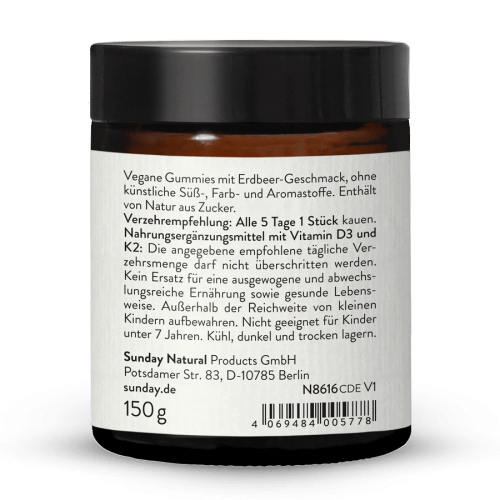
Vitamins D and K2 are cofactors in the regulation of calcium metabolism. Together, the two vitamins control bone-building and bone-degrading cells and important transport molecules that ensure the proper utilisation of calcium. Sunday Natural Vitamin D3 and K2 MK-7 combine the two nutrients in a ratio that ensures optimal interaction.
At present, almost all authorities do not consider vitamin K2 separately, but all vitamins of the K group together. Accordingly, only the statements approved for vitamin K1 currently apply to vitamin K2:
Vitamin K contributes to:
- normal blood clotting
- the maintenance of healthy bones.